What does John Carpenter think people are afraid of?
Halloween (1978)
“All I do is go off instinct… I’m just a poor director trying to get by in this terrible world.” [1]
While it is doubtful that John Carpenter set out to make a film with explicit conservative themes or subversive feminist symbolism, there are compelling arguments to be made for both of these positions. On the other hand, it is abundantly clear that John Carpenter made a film with the intention of scaring the audience, and in that, we see a level of intentionality that is far more indicative of the movie’s true themes and intentions. Dictating the characterization and actions of Michael Myers, John Carpenter creates an icon that is the personification of fear. Fear of what?. Michael Myers represents a fear of strangers, specifically the fear of strange men.
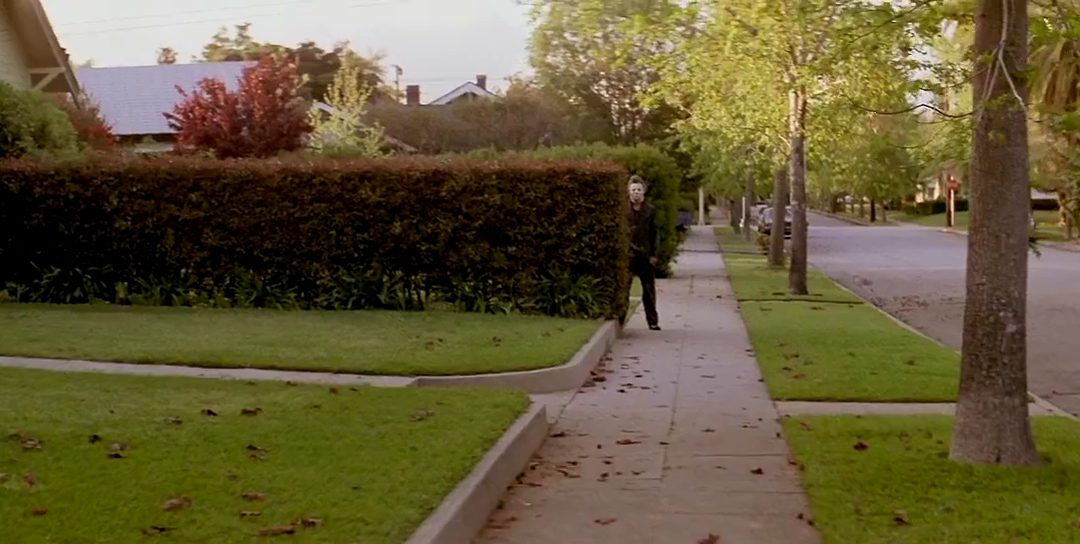
It’s no mistake that in the final credits the actor who plays Michael Myers, Nichola Castle is credited as the shape. Michael Myers is the menacing shape of a man’s silhouette, with a rubber mask of a man’s face. The idea of the film using Michael’s shape to threaten both Laurie Strode and the audience is most explicit during the daytime scenes of the film, where he stands menacingly and ominously in the distance. But it is not just his sudden appearance that is scary– even more unsettling is how he disappears just as quickly. Halloween regularly plays with the implication that the only thing more unsettling than knowing predators like Michael Mayers exist is not knowing where they are.

Halloween (1978)
This is likely what drives the decision to include these daylight sequences in the first place. While many horror movies are set primarily during nocturnal hours, in John Carpenter’s Halloween (1978), there was a deliberate choice to feature Michael Myers stalking Laurie Strode in broad daylight. Danger isn’t confined to moonlit nights and scary stories, real danger exists everywhere– even suburbia, in the unknown intentions of strange men.

[1] https://www.theguardian.com/music/2017/oct/10/john-carpenter-interview-anthology-film-scores
 Zach's Blog About Gender and Sexuality in Film
I like this analysis Zach! I too was intrigued by Carpenter’s use of daylight in Halloween. It struck me as an interesting choice for a slasher film, but I agree with the idea that Michael Myers both elicits fear from the audience, and also represents a greater metaphor of fearing strangers. Seeing as though Myers’ victims are predominantly women, I wonder if this was an intentional choice by Carpenter. There are many analyses that take the theory you posed one step further and state that Myers may represent the patriarchy as a whole. He is a formless “shape” that hovers threateningly over women’s heads, even in broad daylight when most would consider themselves safe. However, I wonder how this theory would relate to a male audience? Women understand the fear, but would men have the same context?
(Also, nice catch with the end credits! I didn’t notice that but it’s certainly interesting!)
LikeLike